
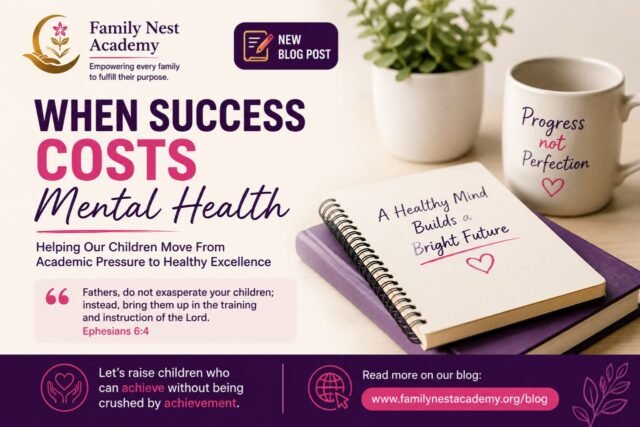
Helping Our Children Move From Academic Pressure to Healthy Excellence
September is a season when many families turn their attention to school, routines, targets, exams, homework, and academic performance.
We want our children to do well—and there is absolutely nothing wrong with wanting them to excel.
But we must ask an important question:
What if our pursuit of academic success is costing our children their peace?
A child can bring home excellent grades and still be struggling emotionally.
They can smile at school and cry alone at night.
They can appear motivated while secretly feeling overwhelmed.
They can be afraid to make mistakes because they believe one poor result means they have disappointed everyone.
Academic excellence should never require a child to sacrifice their emotional wellbeing.
⸻
When Pressure Becomes Too Much
There is a difference between healthy encouragement and unhealthy pressure.
Healthy encouragement says:
“I believe you can do this. Let’s work together.”
Unhealthy pressure says:
“If you don’t succeed, you have failed me.”
One builds confidence.
The other can create fear.
Ephesians 6:4 reminds parents:
“Fathers, do not exasperate your children; instead, bring them up in the training and instruction of the Lord.”
Our responsibility is not simply to produce high achievers.
We are raising whole human beings.
Their emotional health matters.
Their spiritual development matters.
Their relationships matter.
Their character matters.
Their ability to rest matters.
And yes—their education matters too.
But a report card should never become the measurement of a child’s worth.
⸻
What Might Your Child Be Trying to Tell You?
Sometimes children don’t have the words to say:
“I’m overwhelmed.”
Instead, you may notice:
- Irritability
- Withdrawal
- Tearfulness
- Difficulty sleeping
- Loss of interest
- Fear of making mistakes
- Constant perfectionism
- Headaches or stomach discomfort
- Reluctance to attend school
- Becoming unusually quiet
These signs don’t automatically mean academic pressure is the cause, but they are reasons to pause and check in.
Don’t immediately ask:
“Have you done your homework?”
Sometimes the better question is:
“How are you really doing?”
And then give them room to answer.
⸻
Connection Before Correction
When a child struggles academically, our first instinct may be to correct.
“You need to work harder.”
“Why didn’t you revise?”
“Look at your brother.”
“You can do better than this.”
But before correction, try connection.
Ask:
“What was difficult for you?”
“Is there anything you’re worried about?”
“Do you understand what you’re being taught?”
“Are you tired?”
“How can I support you?”
Sometimes the child doesn’t need another lecture.
They need someone to sit beside them and say:
“We will figure this out together.”
⸻
Stop Comparing Their Journey
Comparison can turn education into competition.
“Your sister got an A.”
“Your friend is already ahead.”
“When I was your age…”
But every child is different.
They have different strengths.
Different learning styles.
Different personalities.
Different developmental journeys.
Instead of asking:
“Why aren’t you like them?”
Ask:
“How can I help you become the best version of yourself?”
Our goal should be progress, not perfection.
⸻
Teach Children That Failure Is Not the End
A child who is terrified of failure may eventually become afraid to try.
We need to teach them that mistakes are part of learning.
A poor grade can become an opportunity to ask:
What happened?
What can we learn?
What support do you need?
What can we do differently next time?
A result can be evaluated without attacking the child’s identity.
“You didn’t do well on this test” is very different from “You are not good enough.”
One addresses performance.
The other attacks identity.
Parents, let’s learn to separate the two.
⸻
The Emotional Check-In Every Parent Can Start Today
This week, try something simple.
Create a few minutes where academics are completely off the table.
No grades.
No homework.
No comparisons.
No corrections.
Just connection.
Ask:
“What made you happy today?”
“What was difficult?”
“Is anything worrying you?”
“What do you need from me right now?”
Then listen.
Don’t immediately solve.
Don’t interrupt.
Don’t minimise.
Sometimes being heard is the first step toward feeling safe.
⸻
Our Children Need Balance
We want children who work hard—but also know how to rest.
Children who pursue excellence—but don’t believe perfection is required.
Children who are disciplined—but not driven by fear.
Children who value education—but understand that their identity is bigger than their grades.
Success should develop the child, not destroy the child.
As parents, educators, and caregivers, we have the privilege of creating environments where children can pursue excellence while remaining emotionally healthy.
⸻
Family Challenge
This week, make one intentional change:
Check in emotionally before checking academically.
Before asking:
“How was your test?”
Ask:
“How are you?”
Before asking:
“Have you finished your homework?”
Ask:
“Do you need any help?”
Before correcting:
Connect.
Before comparing:
Encourage.
Before applying more pressure:
Pause and listen.
Because sometimes the child who appears to need more motivation actually needs more support, connection, rest, and reassurance.
Final Thought
Your child’s grades may tell you how they performed in one area.
They do not tell you who they are.
Their value is not determined by their results.
Their future is not destroyed by one difficult academic season.
And their childhood should not be remembered as a constant race to prove they were good enough.
Let’s raise children who can achieve without being crushed by achievement.
Let’s move our families from burnout to balance.
Family Nest Academy
Empowering every family to fulfil their purpose.
Discover more from Family nest Academy
Subscribe to get the latest posts sent to your email.
