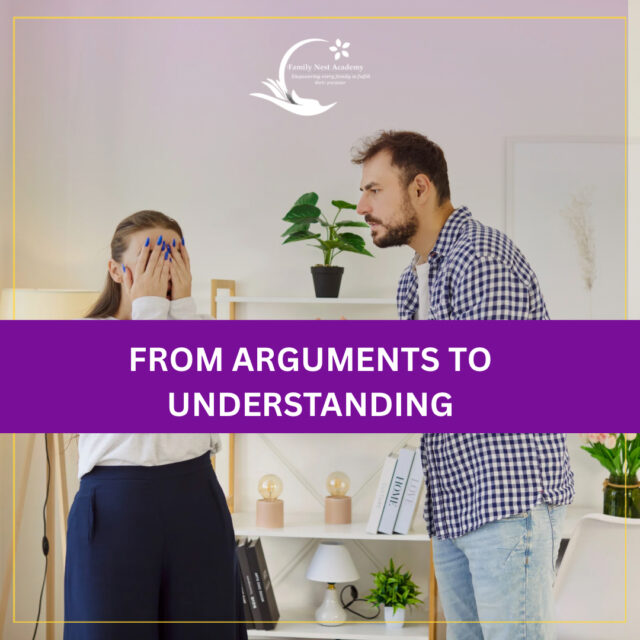
From Arguments to Understanding
Conflict handled well strengthens families. Conflict avoided weakens trust.
Every family has conflict.
A misunderstanding over tone.
A disagreement about responsibility.
A moment where emotions rise faster than wisdom.
Conflict itself is not the danger.
The danger is what conflict becomes when it is handled without understanding.
Many people assume peaceful families are families without arguments. That is rarely true. Strong families are not families that never disagree. They are families that learn how to disagree without tearing trust apart.
When conflict is avoided, issues do not disappear. They settle beneath daily interactions and quietly shape attitudes. Resentment grows in silence. Distance forms where honesty should have lived. Over time, what was avoided becomes heavier than what should have been addressed.
Scripture gives clear direction in Ephesians 4:29:
“Do not let any unwholesome talk come out of your mouths, but only what is helpful for building others up according to their needs.”
This means even difficult conversations must still build, not destroy.
Words spoken during conflict can leave marks long after the argument ends. A family may move on outwardly, yet still carry emotional bruises from how things were said.
Why Conflict Must Be Learned, Not Feared
Research in family relationship studies shows that healthy conflict resolution strengthens emotional security, trust, and long-term communication.
Children especially learn conflict patterns by watching adults:
• If they see shouting, they may copy aggression.
• If they see silence, they may learn avoidance.
• If they see listening and repair, they learn maturity.
Conflict becomes dangerous when the goal changes from solving to winning.
The moment a conversation becomes about victory, understanding leaves the room.
Signs a Family Is Fighting to Win
Sometimes families do not notice when conflict becomes competition.
It often looks like:
• Interrupting before the other person finishes
• Bringing old issues into current disagreement
• Defending before listening
• Using tone to overpower instead of explain
• Focusing on being right rather than being clear
Winning an argument may satisfy pride for a moment, but it often weakens trust.
A child who constantly feels overpowered may stop expressing honestly. A spouse who feels unheard may begin to withdraw emotionally.
What Understanding Looks Like
Understanding does not mean agreeing immediately.
It means making sure the other person feels accurately heard.
This requires slowing down.
Sometimes the strongest thing a parent, spouse, or child can do in conflict is to pause and say:
“What I hear you saying is…”
That single sentence changes the direction of many arguments because it moves the conversation from reaction to clarity.
Practical Ways to Move from Argument to Understanding
- Lower the emotional temperature
Tone often determines whether truth can be received. -
Address one issue at a time
Too many unresolved topics create confusion. -
Ask clarifying questions
Understanding grows when assumptions are reduced. -
Separate the issue from the person
Disagreement should never attack identity. -
Prioritize repair after tension
Conflict should not leave permanent distance.
Reflection
Do we fight to win or fight to understand?
When conflict rises, what matters most to us, proving a point or preserving connection?
That answer reveals the emotional culture of a home.
Action
Pause in the middle of conflict and restate the other person’s point.
Before responding, say:
“Let me make sure I understand what you mean.”
That simple pause often prevents unnecessary damage.
A Final Thought
Families do not become stronger because conflict disappears.
They become stronger because conflict becomes wiser.
When arguments become opportunities for understanding:
• Trust deepens
• Communication matures
• Respect grows
• Emotional safety increases
And children learn that disagreement does not have to threaten love.
Sometimes the greatest victory in conflict is not winning.
It is understanding well enough to stay connected.
Family Nest Academy
Discover more from Family nest Academy
Subscribe to get the latest posts sent to your email.
