
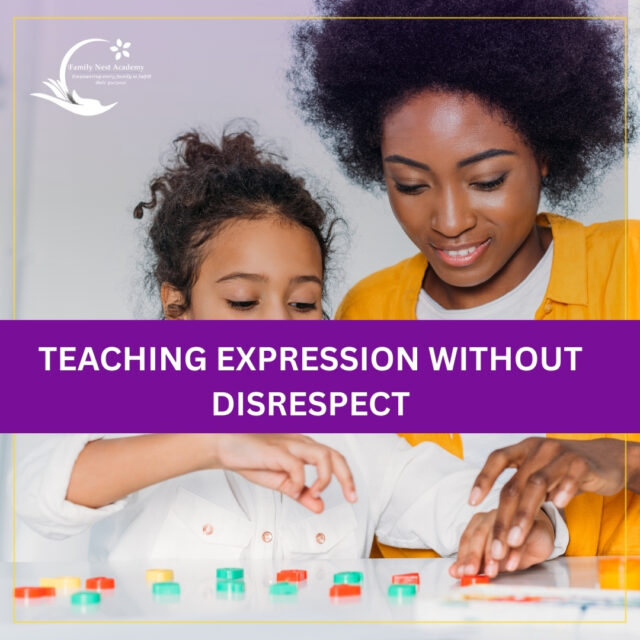
 Children must learn how to express emotions without exploding or withdrawing.
In many homes, emotions show up in two extremes.
Some children explode when they are frustrated.
Others withdraw and say nothing at all.
Both responses carry the same message:
“I do not yet know how to express what I feel safely.”
Emotional expression is a skill. It is not automatic. Children learn it the same way they learn language, through observation, repetition, and guidance. If the emotional environment around them is loud, reactive, or dismissive, they often copy that pattern. If the environment is calm and respectful, they learn that their voice can exist without becoming harmful.
Scripture reminds us of the power of tone.
Proverbs 15:1 says, “A gentle answer turns away wrath, but a harsh word stirs up anger.”
This principle applies strongly in families. When correction is harsh, emotions escalate. When communication is gentle but firm, hearts remain open.
Children must be taught two truths at the same time:
Your feelings matter. Your delivery matters too.
Healthy expression allows emotions to be shared without harming relationships.
Why Emotional Expression Matters
Research in child development shows that children who can identify and express emotions appropriately tend to have:
•Stronger social relationships
•Better conflict resolution skills
•Lower levels of anxiety and aggression
•Greater emotional resilience
When children cannot express emotions well, frustration often leaks out as disrespect, defiance, or withdrawal.
The goal of parenting is not emotional suppression.
The goal is emotional direction.
Teaching Children How to Express Emotions Well
Parents can intentionally guide children toward respectful communication by practicing these principles:
1. Teach emotional vocabulary
Children cannot express what they cannot name.
Help them identify feelings such as frustration, disappointment, embarrassment, or anxiety.
2. Separate emotion from behaviour
Feeling angry is normal.
Shouting, insulting, or slamming doors is not acceptable.
3. Slow the emotional moment
When emotions rise, pause the situation rather than escalating it. Calm moments create better conversations.
4. Practice respectful disagreement
Allow children to express different opinions while guiding them toward respectful language.
5. Reinforce positive expression
When a child communicates feelings calmly, acknowledge it. Recognition strengthens the behaviour.
The Role of Parents: Modeling Matters
Children do not only listen to what we say.
They study how we say it.
If our tone is sharp, impatient, or dismissive, they learn that communication equals conflict. But when they see adults regulate their emotions, they learn that calm expression is possible even during correction.
This is leadership by example.
Parents who practice calm communication teach children a powerful lesson:
Strong emotions do not have to destroy relationships.
Reflection
What tone dominates our conversations at home?
Is it rushed, reactive, and tense?
Or calm, patient, and constructive?
The emotional climate of a home shapes how children speak, respond, and resolve conflict.
Action
Model calm communication even when correcting.
Take a breath before responding.
Lower your tone rather than raising it.
Speak with clarity instead of anger.
When children repeatedly experience calm correction, they begin to mirror it.
A Final Encouragement
Teaching children how to express emotions respectfully is one of the greatest life skills a parent can offer. It equips them to handle friendships, relationships, leadership, and conflict throughout life.
When families build a culture of respectful expression, something powerful happens.
Voices are heard.
Hearts remain connected.
And emotions become tools for understanding rather than weapons of harm.
Start today. Lead the tone you want your children to follow.
©️Family Neet Academy
Discover more from Family nest Academy
Subscribe to get the latest posts sent to your email.
